Rusniture Recycling Icon: A Versatile Vector Asset for Sustainable Design
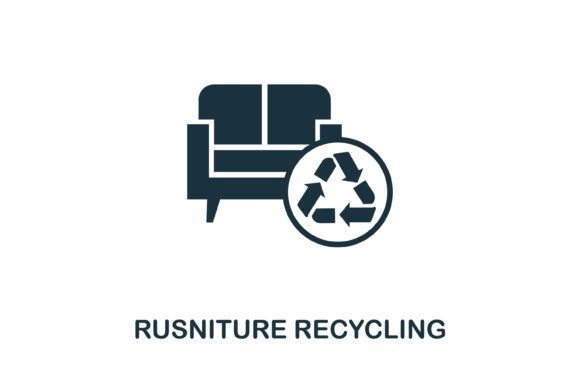
In the evolving landscape of digital and print design, visual communication regarding sustainability has moved beyond generic green arrows. As businesses and organizations strive to articulate specific environmental initiatives, the need for specialized graphical assets has grown exponentially. The Rusniture Recycling Icon emerges as a distinct solution within this niche, bridging the gap between general waste management symbolism and the specific context of furniture recovery and repurposing. This vector graphic asset serves not merely as a decorative element but as a functional tool for conveying complex circular economy concepts through simple, recognizable imagery.
For designers, marketers, and business owners, understanding the utility and application of this specific icon is essential for creating authentic sustainability narratives. Unlike standard recycling symbols that imply industrial processing, the Rusniture Recycling icon suggests restoration, reuse, and the extension of product lifecycles. This distinction is critical when communicating with an audience that values craftsmanship and resource conservation over mere disposal.
Defining the Visual Language of Furniture Recovery
The primary value of the Rusniture Recycling icon lies in its semantic precision. In user interface design and infographic creation, ambiguity is the enemy of effective communication. When a user encounters a standard Mobius loop, they understand "recycle." However, when they encounter a symbol specifically designed around furniture or wood reclamation, they understand "restore," "upcycle," or "second-life."
This creative asset typically integrates motifs associated with both domestic furnishings and cyclical renewal. It functions as a visual shorthand that reduces cognitive load for the viewer. Instead of requiring paragraphs of text to explain that a company accepts old chairs for refurbishment rather than melting them down into plastic pellets, the icon establishes this context instantly. For web design templates focused on eco-friendly home goods, vintage marketplaces, or municipal bulk-waste programs, this specificity enhances user experience by aligning visual cues with actual service offerings.
Technical Specifications and File Utility
Practical usability defines the success of any design asset. The Rusniture Recycling Icon is structured to accommodate various production environments through two primary file formats:
- EPS (Encapsulated PostScript): This vector format is the industry standard for professional editing. Because it is mathematically defined rather than pixel-based, the EPS file allows designers to scale the Rusniture Recycling icon to the size of a billboard or shrink it to a favicon without any loss of quality. Crucially, it remains fully editable in software like Adobe Illustrator or CorelDRAW, enabling color adjustments, line weight modifications, and integration into larger composite illustrations.
- JPG (Joint Photographic Experts Group): While less flexible than vector formats, the included JPG file provides immediate utility for non-designers or quick mockups. It serves as a ready-to-use raster image suitable for office documents, basic presentations, or social media posts where vector support is unavailable.
This dual-format delivery ensures that the asset is accessible to both seasoned graphic professionals and general consumers who may lack advanced design software. The "easy to edit and use" promise is fulfilled by providing a clean, layered vector structure that respects professional workflows while offering a plug-and-play option for casual users.
Strategic Applications Across Industries
The versatility of the Rusniture Recycling Icon extends across multiple sectors. Its application is not limited to recycling centers; it is equally valuable in retail, education, and corporate reporting. Understanding where to deploy this symbol can significantly enhance brand messaging and operational clarity.
E-Commerce and Retail Signage
For online retailers specializing in refurbished or sustainable furniture, trust is a primary conversion factor. Customers need assurance that "recycled" means high-quality restoration. Placing the Rusniture Recycling icon on product pages, filter menus, or checkout screens reinforces the value proposition. It acts as a certification mark of intent, signaling that the item has been diverted from landfills through thoughtful intervention. In physical retail spaces, this icon can guide customers to specific sections dedicated to upcycled goods, improving navigation and highlighting inventory that aligns with ethical consumption values.
Corporate Sustainability Reporting
Annual ESG (Environmental, Social, and Governance) reports often suffer from dense text and repetitive charts. Incorporating the Rusniture Recycling icon into infographics helps break up data-heavy sections. When illustrating metrics related to office furniture liquidation, donation programs, or internal asset recovery, this specific symbol adds narrative depth. It transforms abstract tonnage statistics into tangible stories about resource stewardship. Stakeholders reviewing these documents can quickly identify sections relevant to material circularity, making the report more navigable and engaging.
Educational and Community Outreach
Municipalities and non-profits frequently struggle to communicate proper disposal methods for bulky items. A generic recycling bin sign does not adequately address mattresses, sofas, or wooden cabinets. Using the Rusniture Recycling icon in community guides, website portals, and signage at transfer stations clarifies expectations. It educates the public on the difference between trash and recoverable resources. By visually distinguishing furniture recycling from general waste, communities can reduce contamination rates and increase participation in specialized recovery programs.
Evaluating Suitability for Your Project
While the Rusniture Recycling icon is a powerful asset, it is not a universal replacement for all environmental graphics. Determining whether this specific illustration suits your needs requires careful consideration of your project’s scope and audience expectations.
Consider the Context of Materiality: If your project involves mixed-material recycling (e.g., electronics, glass, and metal alongside wood), a broader symbol may be more appropriate. The Rusniture icon is most effective when the focus is explicitly on furniture, timber, or upholstery. Using it for general e-waste could create confusion regarding accepted materials.
Assess Brand Alignment: The aesthetic of this icon should harmonize with your existing visual identity. Because it is provided as an editable EPS, you have the freedom to adapt its style. However, if your brand relies on hyper-minimalist line art and the icon is inherently illustrative or detailed, you may need to invest time in simplifying the vector paths. Conversely, if your brand is rustic or artisanal, the inherent character of a furniture-specific recycling symbol will likely integrate seamlessly.
Verify Licensing and Usage Rights: Always review the specific license agreement accompanying the download. While the files are easy to edit, usage rights vary. Ensure that your intended application—whether commercial, editorial, or personal—is permitted. For large-scale campaigns or merchandise, confirming that the license covers such uses prevents future legal complications.
Best Practices for Implementation
To maximize the effectiveness of the Rusniture Recycling icon, adhere to established design principles that prioritize accessibility and clarity.
- Maintain Visual Hierarchy: Do not let the icon compete with primary calls to action. It should support the content, not dominate it. Use whitespace effectively to give the symbol room to breathe, ensuring it is legible at smaller sizes.
- Ensure Color Contrast: Sustainability graphics often default to green, but this is not always accessible. Test the icon against your background colors to ensure sufficient contrast ratios for visually impaired users. The editable nature of the EPS file allows you to adjust fills and strokes to meet WCAG accessibility standards without compromising recognition.
- Pair with Descriptive Text: Never rely solely on the icon to convey critical instructions. Always pair the Rusniture Recycling icon with clear, concise labeling such as "Furniture Drop-off," "Refurbished Collection," or "Wood Recovery." This redundancy ensures comprehension across diverse audiences and cultural contexts.
- Consistency Across Touchpoints: Use the same iteration of the icon across all platforms. If you modify the color for your website, apply the same modification to your printed brochures and social media templates. Consistent visual language builds familiarity and trust over time.
The Broader Impact of Specialized Icons
The existence and utilization of assets like the Rusniture Recycling Icon reflect a maturing approach to environmental communication. We are moving past the era of one-size-fits-all eco-symbolism into a phase of nuanced, sector-specific visual vocabularies. This shift benefits everyone involved. Designers gain tools that reduce the need for custom illustration from scratch. Businesses gain credibility through accurate representation of their services. Consumers gain clarity, empowering them to make informed decisions about waste and consumption.
Ultimately, this icon is more than a collection of vector points and curves; it is a facilitator of sustainable behavior. By making the concept of furniture recycling visible, distinct, and aesthetically integrated into our digital and physical environments, we normalize the practice. Whether used in a high-end web template, a municipal pamphlet, or a corporate presentation, the Rusniture Recycling icon performs the quiet, essential work of connecting people with the systems that preserve our material world. Its ease of editing and broad compatibility ensure that this connection remains accessible to creators of all skill levels, fostering a more visually literate and environmentally conscious design ecosystem.